Be smart, not careful

Growing up I distinctly remember my parents telling me ‘Be careful!’ when dropping me off for school, and then yelling it as I was walking out the door to go dancing with friends. Even as an adult going off to college, or going on a trip: ‘Be careful!’. These words have lived in my mind for decades, and I kind of wished they hadn’t.

Being careful implies avoiding danger at all costs; removing ourselves from situations that might cause us harm, pain, or discomfort. The problem is that life comes with risks. Uncertainty is inherently associated with new experiences; and unless we are willing to take those risks, we are sure going to miss out a lot.

I have lived my life cautiously. Almost every decision I have ever made has been taken with caution—extreme caution. From the most trivial decisions, like bringing an extra sweater to an outing ‘just in case’, to the most transcendent ones like buying a car or moving to a new city. I was taught to look at every scenario, to ask what could go wrong, and to always have a plan B. And so, I lived my life on the uneventful side, the predictable side, the safe side.

I was always the kid with the extra sweater, scarf, and jacket… just in case. To date I am the woman who always carries extra cash, a water bottle, and a pen… again, just in case. Don’t get me wrong, there is nothing wrong with being prepared; I thrive on preparedness, on having a plan, a schedule, a to-do list. The problem is when you refrain from being spontaneous because it isn’t on the list, or it doesn’t fit in the schedule. When our lists and preparedness get in the way of living, something has got to change.


Being careful keeps you safe but isolated. You cannot live life to its fullest, so you stay whole and incomplete at the same time. Making mistakes, failing, and being heartbroken are all part of life; they help us grow, and teach us valuable lessons. In her podcast, The Happiness Lab, Dr. Laurie Santos explains that humans are naturally drawn to sharing. When we share an experience with others our emotions and feelings are intensified. There is a sense of belonging in knowing that others have also experienced what we have. But, how can we ever relate to others if we have missed out on so many experiences? Being too careful can be alienating.

Being careful makes you scared. You know they say it is worse not knowing? It is true. Our minds are powerful, and uncertainty about an event opens the doors of creativity which allows us to manufacture a variety of scenarios ranging from mild to full psychotic (most of us like to dwell on the later). Conquering a fear might be uncomfortable, it might be scary, it might even be painful, but at the end it is no longer uncertain. It becomes measurable, finite, you can give it a number or a name, you have control over it. This means that it will be easier next time you do it because “it wasn’t that scary the first time” or “yes, it was scary, but now I know what to expect”. By choosing not to participate in certain activities we give up our power over them, we let them control us. By being too careful, we allow our fears to steal precious memories and essential lessons from us.

Being smart, as opposed to careful, means that you take a situation, you analyze it and you decide whether or not to act on it, rather than dismiss it altogether because it might be dangerous. It means that you take a risk, because the pay off might be greater than the downside. It means that you come to terms with the fact that you will get burnt from time to time, you will fall, and you will be heartbroken. But it will also mean that you will experience love, success, and amazement. It means that you will experience the full spectrum of emotions; you will live life to the fullest, with its ups and down.

Being smart allows us to acquire one of the most, if not the single most important skill in life: resilience. Pick up a psychology book, or a self-improvement book—any book; you will find without a doubt an emphasis on the importance of resilience, the ability to recover quickly from difficulties. A study by Dr. Seligman back in the 1980’s done on college freshmen at University of Pennsylvania concludes that it is the ability to recover quickly from difficulties or failure what successful college students have that their peers don’t. It is not talent, but resilience that leads to success. The thing about resilience, is that you can’t get up if you haven’t fallen. You can’t try again if you haven’t lost. As much as it hurts, falling is an essential part of life. Every scar comes with an amazing story. Collect those!

“My hunch is that for a given level of intelligence, your actual achievement is a function not just of talent, but also of the capacity to stand defeat.”

“It is the combination of reasonable talent and the ability to keep going in the face of defeat that leads to success.”

“What you need to know about someone is whether they will keep going when things get frustrating.”

Dr. Daniel Goleman.
“Research affirms power of positive thinking”. Daniel Goleman. New York Times. Feb 3, 1987

My advice, to young and old alike, is to be smart, not careful. You don’t have to sell everything you own and start a new life right away, although it wouldn’t be the worst idea. Start small, try a different thing from the menu, that one item you have always been curious about; or talk to a stranger in the bus, ideally a normal looking person; or maybe pick up a new hobby, something your inner child would be proud of. Build off from that and allow yourself to grow.

If I could go back in time I would tell my 15-year old self: ‘Be smart, not careful. Take risks, venture, experiment! You will learn more about yourself by failing that you ever will by succeeding.’ I am not saying to throw caution to the wind, I am saying be smart about it. Consider the pros and cons, evaluate your options, play the odds. If it comes down to a 50-50 chance, take it! Get out of your comfort zone, make some memories and live.

“Christopher Columbus”
The responsibility that matters the most

As individuals who form part of a community, where ever we may be, we inherently have certain responsibilities to do no harm and to respect others. Really most of our civic duties could be summarized to never do anything that would purposely harm others. And while following these do-not-harm responsibilities should be more than enough to keep the peace and promote a safe environment to live in, I believe we also have a civic responsibility to actively and positively impact others.

It may be because I have lived abroad—in a country where people actively engage in their communities—that I believe we have a civic duty, to actively contribute to the betterment of our own specific communities. I believe we should care about raising the living conditions of those around us. I believe we should care about issues that do not necessarily affect us specifically. I believe we should be considerate of other people’s struggles, and more importantly, we should do whatever is in our power to fix them.

This week, I was touched by two examples of selfless people acting on behalf of others in their communities. Kelly Jensen is someone that I initially began following on Instagram because of her Utah-famous “Live Lists.” But in the 5+ years that I have followed her, I have been humbled by her courage and initiative to change the world, one small action at a time. This week, she rallied people to stop Jordan’s school district from cutting special needs programs in their high schools. People from all over the world, signed a petition—not particularly because it affected them, but because they understood that there are things that make our communities as a whole better (heck, I signed the petition 3000 miles away! fully knowing it would not change a thing in my life but because it was the right thing to do)—to voice their disagreement with this decision and ask Utah’s education system to keep in place these programs that are vital to some families. I was in awe at how quickly Jordan’s school district retracted from cutting these programs, all because people stood by each other in camaraderie.

The second act that I was deeply touched by was the story about two pianos between a wall. Two neighbors that shared more than a wall. Through the power of music, two neighbors connected and helped heal each other. Emil, a 78 year old, had lost his wife in December and had been alone in his temporary accommodation while his house was being sold. Giorgo was his neighbor, and while they never had met each other, they started to play music through the wall. Though the story has a bittersweet end, it totally portraits my point of selflessly looking to support people in your community.

“Never doubt that a small group of thoughtful, committed citizens can change the world. Indeed, it is the only thing that ever has.”

Margaret Mead

To act and not be acted upon. To be a force of change. To purposefully walk the path of improvement.

Of all the things for which we should feel responsible, I believe the most important one (and really the only one responsibility that will have a transcendental impact once we leave this earth) is to positively impact the lives we touch. So above all of the responsibilities we may have, let changing the lives we come in contact with for the better be the most important one.

Outgrowing

Oxford Dictionaries define outgrowing as “grow too big for (something).” // “leave behind as one matures.” Lately, I’ve been thinking about outgrowing, about the painful experience that outgrowing implies.

We outgrow seasons of life.

We outgrow friends.

We outgrow jobs.

We outgrow places.

I’ve outgrown my college years. Happy as I was then, I wouldn’t go back to them. Because I now see the bubble that college is. I now know the realities of living a more mature lifestyle just as much as I know the joys of it.
I’ve outgrown friends, due to one’s fault really. Because life is like that… kind enough to connect you with people who resonate with you in a specific way for a specific period of your life, but cruel enough to take each of you onto different paths. And that’s okay.
I’ve outgrown jobs; jobs that were right for a specific time in my life: some gave me the warm comfort that came from the longevity and familiarity of it, some pushed me to be brave, to believe I could do hard things, some made me humble, some enhanced abilities for which I am grateful today. But at some point, in all of them, I reached a point where I needed to move on for reasons as different as day and night; but all with the shared reason that I had already learned the lesson(s) I needed to learn.
I’ve outgrown places too. I outgrew my one-bedroom rental in Texas. I outgrew my apartment in D.C. I outgrew apartments in Mexico City. And, though hard to accept, perhaps I have also outgrown the apartment that I have loved the absolute most: the apartment that for four years held me in my solitude and brokenness, the apartment that carried me through many disappointments, the apartment that celebrated a few major, life-changing milestones, but also many—perhaps mundane, but just as necessary—minor daily wins. Perhaps I’ve outgrown Cornerstone #55 too.

But also implicit with outgrowing, comes the (sometimes unknown) blessing of starting new seasons of life, of making new friends, of findings new jobs, of filling up new spaces. Maybe even the opportunity to start all over again, just with the big difference of now being a better, stronger, and hopefully, a kinder version of yourself.

Climb your own ladder!

One of the things I hate about watching the Super Bowl in Mexico is that I don’t get to see all the commercials. Because who am I kidding? I am there only of the commercials and the food. I have not seen all of the 2021 commercials, but I don’t have to because THIS takes the cake.

Like what a brilliant idea was it to change the lyrics of 9 to 5 (the iconic hymn of the working class!) to not only promote, but even encourage entrepreneurship. I remember reading in Outliers by Malcom Gladwell, that entrepreneurs are influenced by the constraints and events of their times. Additionally, children are influenced by their parent’s success in their careers/jobs (frustratingly, I cannot remember where I read this). I find it interesting to see many people starting new businesses while this pandemic has been going on. In fact, in March 2020, there were 804,398 businesses that were less than 1 year old, an increase on the March 2019 figure of 770,609. If starting a new business and materializing an idea requires such bravery and courage, I cannot image the additional amount that it requires to start a new business that starting a new business take.

Recently I have seen so many people starting a new business and it has been so refreshing, even contagious. I believe that at some point we all think about starting a new business, and maybe we all should try, in as much as possible, to make it happen. Even if it fails, I think there are many valuable lessons that can be learned from building something from the ground up.

2020

As we close this chapter called ‘2020,’ I feel like I need to say a proper goodbye.

2020, the truth is that you were a really sucky year. You took away big things… birthday celebrations, family gatherings, coffee with friends and just all-kind of gatherings. You robbed us important moments… from gathering together to mourn our loved ones to gathering to celebrate Christmas. Travel plans along with any hope of vacation and time-off. You took our normality away. No longer were we able to go to the office and leave our work once we stepped out. In a blink of an eye, our lives, our homes and our spaces were invaded. We now had to carry the burden of work within our own homes, our own space.

And you also took away the small thing—small things that now seem the biggest things. Eating chips in the supermarket while grocery shopping, eating out with friends, shopping from street vendors, browsing endlessly the supermarket aisles for hours on end and even smiling random people on the streets. Being able to leave the house without a mask or hand sanitizer. Having very dry and sore hands from disinfecting every single thing thoroughly, groceries, cellphone, pocket change or credit cards.

But I have always believed that how you react to something is more important than that which you are faced with. To be fair, you did give us something for which I am finding myself grateful for, and that is time with ourselves. Having to spend any spare time with only you, has made me come to know myself better. I have realized what it’s essential for me and what is not. I now know where my values are, what are the things that are really important to me . And for this self-knowledge I am very appreciative.

I recently read a reflection from one of my favorite authors, where she traced the good things in her life backwards, and how many of the things were the result of seeds that were unknowingly planted ‘years and months and days before.’ I think that one day we are going to be able to look back to 2020 and understand why it was important to live this year the way we did and hopefully, it will all make sense.

I am happy, even with all of the hardships and challenges that this year brought, for this year. But I am not going to lie, I am also pretty happy for the new year. Though I am certain that our reality will not change when the clock strikes midnight, I am happy for a new year. Hopefully one with more growth and appreciation.

Enneagram

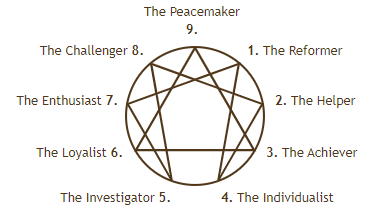
Last week, I heard someone asking about someone’s enneagram. I was intrigued about it so I immediately googled it (on a side note… I find it funny that google is now a verb. How crazy is it?). Any way… where was I? Right! The enneagram is a personality system of nine types of personalities. While it’s uncertain whether this type is genetically determined, many believe it is already in place at birth. The nine types (or “enneatypes”, “ennea” means “nine”) are universally identified by the numbers 1 to 9. These numbers have a standard way of being placed around the Enneagram symbol.

Because I was curious as to what mine would be, I took the test. There were some questions within the test that just “clicked” in the sense that they very eloquently described how I feel/behave in some circumstances. For instance:

I accumulate lots of knowledge to counteract my lack of self-confidence (this one hurt lol)

Change-whether to a new job or a new school makes me more anxious than it does most people

I have been told I am a perfectionist and I suppose it is true (got a comment way to recently about this)

I seldom compromise my principles

I see all points of view when there is a dispute, so it’s hard for me to take a side

Sometimes I am too critical of others but I am much harder on myself than I am on others

and my personal favorite…

It really bothers me when people don’t say thank you 🙂

Initially—without knowing much about each of the type—I thought I would either be a type 3 or a 6. The test results said I am most likely a type 1… The Reformer. After reading the description, I cannot say I am surprised.

The Reformer: Perfectionists, responsible, fixated on improvement.

People of this personality type are essentially looking to make things better, as they think nothing is ever quite good enough. This makes them perfectionists who desire to reform and improve; idealists who strive to make order out of the omnipresent chaos.

Ones have a fine eye for detail. They are always aware of the flaws in themselves, others and the situations in which they find themselves. This triggers their need to improve, which can be beneficial for all concerned, but which can also prove to be burdensome to both the One and those who are on the receiving end of the One’s reform efforts.

The One’s inability to achieve the perfection they desire feeds their feelings of guilt for having fallen short, and fuels their incipient anger against an imperfect world. Ones, however, tend to feel guilty about their anger. Anger is a “bad” emotion, and Ones strive sincerely and wholeheartedly to be “good.” Anger is therefore vigorously repressed from consciousness, bursting forth in occasional fits of temper, but usually manifesting in one of its many less obvious permutations – impatience, frustration, annoyance and judgmental criticality. For this reason, Ones can be difficult to live with, but, on the high side, they tend to be loyal, responsible and capable partners and friends.

Ones are serious people; they tend to be highly principled, competent and uncompromising. They follow the rules and expect others to do so as well. Because they believe so thoroughly in their convictions, they are often excellent leaders who can inspire those who follow them with their own vision of excellence. Reform movements are frequently spearheaded by Ones.

Ones are often driven and ambitious, and are sometimes workaholics. But whatever their professional involvement, they are definitely active, practical people who get things done. They are natural born organizers, listmakers who finish everything on the list, the last one to leave the office, the first one to return, industrious, reliable, honest and dutiful.

The relentlessness of their pursuit of the ideal can make Ones tense people who have a hard time relaxing and who unnecessarily deny themselves many of the harmless pleasures of life. They tend to be emotionally repressed and uncomfortable with expressing tender feelings; they generally see emotionality as a sign of weakness and lack of control. They are seldom spontaneous. They have multiple interests and talents however; they are self-reliant and seldom run out of things to do.

I think that for the most part, the type nailed it on the head. Like… workaholic? count me in! eye for detail? here for it! self-denaying? who? me?

Loneliness of…

Instagram is a funny place. There have been times when scrolling through Instagram has made me feel not so very good about my life. It’s extremely easy to—unconsciously and unwillingly—fall into the comparison trap. You see people with seemingly better lives, better homes, better friends, better families. But sometimes, some lucky times, you get across some jewels.

This week, I came across this jewel… about the types of loneliness by Mari Andrew. This post resonated with me in a deep way because some of them hit right home. And like the over-thinker that I am, I just kept thinking of the type of loneliness I have experienced and needed to put some of them into words…

Loneliness of failing a test

Loneliness of getting a no for an answer when you were really hoping for a yes

Loneliness of starting over in a new city

Loneliness of being physically present in one a place, but your heart being somewhere else

Loneliness of a missed opportunity

Loneliness of could have’s/should have’s

Loneliness of shouldering financial burdens by yourself

Loneliness of making ends meet

Loneliness of pain

Loneliness of being in a room full of people yet feeling so very alone

Loneliness of not feeling enough

Loneliness of overlooked efforts

Loneliness of an unkind word lingering in your head and worse, in your heart

Loneliness of not being home

Loneliness of spending a birthday alone

Loneliness of sitting in the chapel by yourself while everyone else is surrounded by their families

Loneliness of feeling stuck

Things I’ve learned in 26 years

November 11th 2020. Here we are again. This year has not been what I expected at all. As a matter of fact, it has not been what any of us expected from 2020. But perhaps more than any other year, today I am truly grateful to be alive. I am grateful for my health, for my financial and mental stability. I am grateful for the many good things that have happened in these past 365 days. I am even grateful for the few days of the year that were lows for me, because at the end of the day, they have also proven to be valuable lessons.

In a true COVID-19 fashion, there was a zoom celebration. I feel also very grateful, and lucky, for my team at work. They are really great!

Without further adieu, and to continue the tradition, here’s the list of things I learned this year:

  1. Friends—good friends—are really worth a thousand rubies!
  2. We all need help every now and then and this reaching out for it is nothing to be ashamed of.
  3. Never cry in front of your boss.
  4. How to roast a chicken.
  5. Bite your tongue before speaking with a hot head.
  6. It’s important to do well in this life, but it is more important and of more transcendence, to do good.
  7. Don’t trust people who belittle others when in private.
  8. Respect is earned. It you need to make people respect you, you have already lost it.
  9. Life is unexpected… enjoy the little things!
  10. Be grateful, and never ever complain again about doing grocery shopping.
  11. A kind word can make a difference.
  12. Life is not fair.
  13. Don’t fall into the comparison game, you’ll seldom end up winning.
  14. Sing. And do it loudly and proudly.
  15. You need someone to be in your corner. Don’t sub-estimate the power of an ally.
  16. Never prioritize a problem over a person.
  17. Build your social capital at work, but do it selflessly and without an agenda.
  18. No matter who you are, the way you treat people does not go unnoticed.
  19. Exercise does make you happy. It just does.
  20. You never know how much you can love a dog until you have one.
  21. Food storage is important.
  22. Do no harm, but take no sh*t.
  23. We have a living prophet in this latter days.
  24. The way you allocate your time, shows you your true priorities.
  25. Define what is worth dying for.
  26. Life is short. As overused as the phrase might be, life is truly short. I hope that from this day onward, I never take it for granted.

Higher Ground

This past week I discovered that Michel Obama has a podcast. I listened to the two episodes that were available. My first impression? It feels very organic and natural. The podcast is really easy to follow, nothing that requires a ton of concentration, but it still makes you consider and re-consider what you think about issues that are relevant right now.

I specially loved these couple of quotes. They are short but contain deep truths.

“Build lives that are selfless.”

Michelle Obama

“Don’t reach for normal, reach for better.”

Michele Norris

I’m glad I have this new podcast. I had fallen into a rut , so I am excited to have something to get excited about.